E-commerce Site Optimization
Accelerate your online store to sell more
Is your e-commerce slow? Every lost second costs sales. Optimize the speed and conversion rate of your existing store.
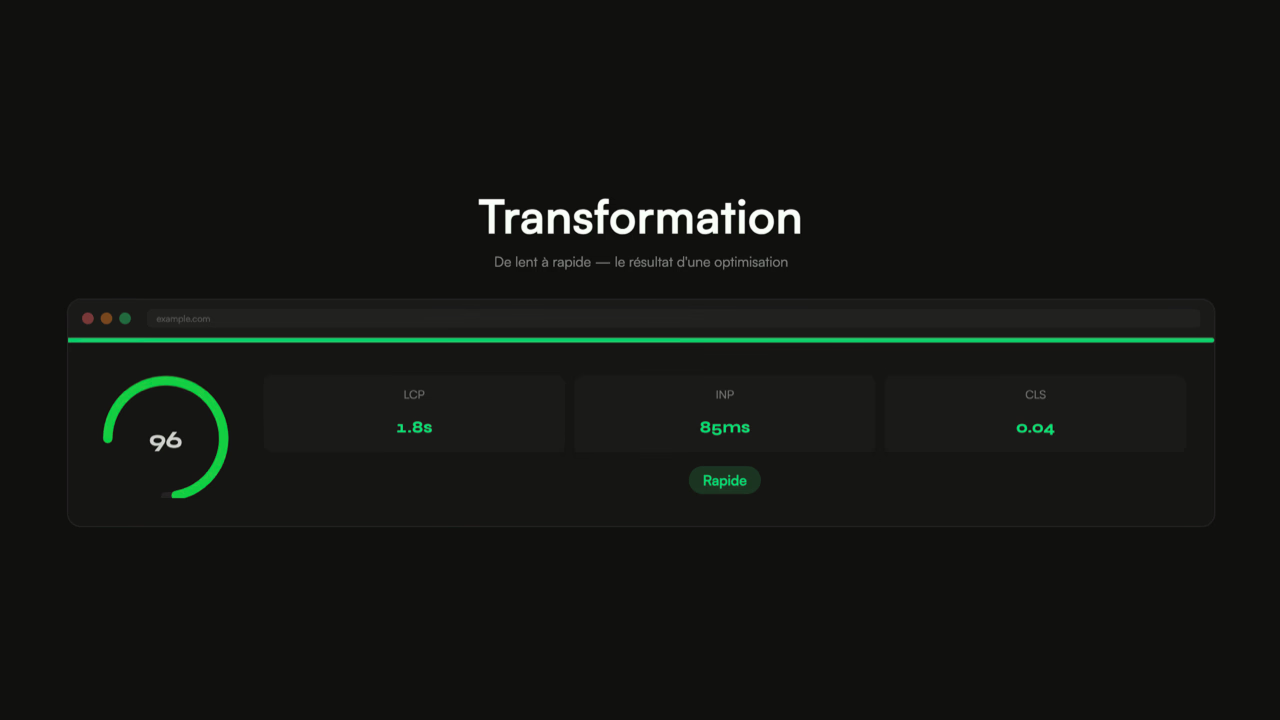
Transformation
From slow to fast – the result of optimization
LCP
—INP
—CLS
—
Trusted by leading brands
8 years, 35+ brands supported on high-stakes websites.











La vitesse, levier n°1 du e-commerce
Ce que j'optimise sur votre boutique
L'optimisation e-commerce agit sur tous les leviers qui freinent vos ventes : vitesse de chargement, fluidité du parcours d'achat et performance perçue par l'utilisateur.
⚡ Vitesse de chargement
Optimisation des images produits, du CSS/JS, du cache et du rendu pour des fiches produits et pages catégories qui s'affichent instantanément.
? Tunnel d'achat fluide
Réduction des frictions dans le parcours d'achat : panier réactif, étapes de checkout allégées, paiement sans latence.
? Performance mobile
60% de votre trafic est mobile. J'optimise spécifiquement l'expérience sur smartphone : interactions tactiles, chargement sur réseau 4G, poids des pages.
? Scripts tiers maîtrisés
Tracking, widgets et scripts marketing pèsent souvent plus que votre site lui-même. Je les audite, les optimise ou les remplace pour retrouver de la vitesse.
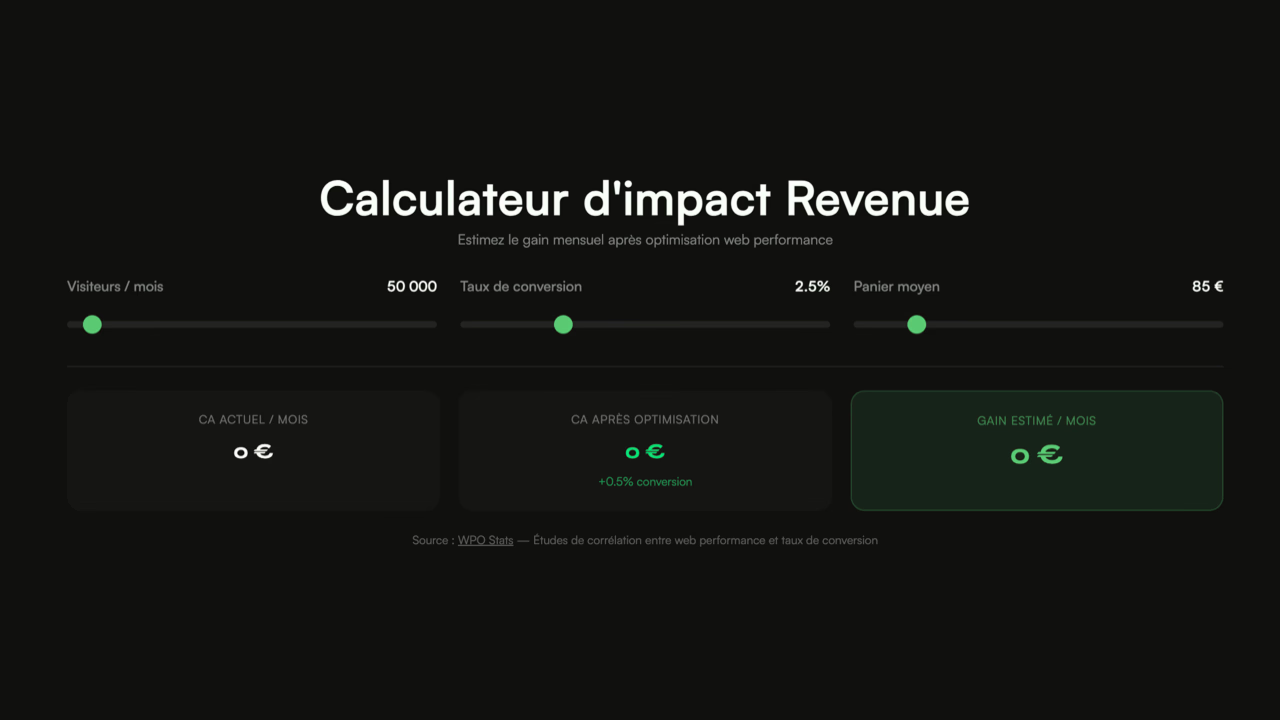
Combien vous coûte un site lent ?
Revenue Impact Calculator
Estimate your monthly gain after web performance optimization
Current revenue / month
$0Revenue after optimization
$0+0.5% conversion
Estimated gain / month
$0Source: WPO Stats — Correlation studies between web performance and conversion rates
Comment se déroule l'optimisation ?
Un processus éprouvé pour des résultats mesurables
Plan de priorisation
Identification des quick wins et des chantiers de fond, priorisés par impact sur le chiffre d'affaires et complexité d'implémentation.
Optimisation itérative
Implémentation par lots avec mesure de l'impact de chaque optimisation. Chaque changement est validé avant de passer au suivant.
Mesure des résultats
Comparaison avant/après sur les métriques de performance et les KPIs métier : taux de conversion, panier moyen, taux de rebond.
Plan de priorisation
Identification des quick wins et des chantiers de fond, priorisés par impact sur le chiffre d'affaires et complexité d'implémentation.
Optimisation itérative
Implémentation par lots avec mesure de l'impact de chaque optimisation. Chaque changement est validé avant de passer au suivant.
Mesure des résultats
Comparaison avant/après sur les métriques de performance et les KPIs métier : taux de conversion, panier moyen, taux de rebond.
Résultats constatés sur des boutiques e-commerce
ROI mesurable ou intervention gratuite
Si l'optimisation de votre boutique n'améliore pas vos Core Web Vitals et votre taux de conversion sous 30 jours, je retravaille gratuitement jusqu'à atteindre les objectifs fixés ensemble.
Ce qu'en disent mes clients
Excellent work.
Paul has significantly improved the site's speed and perfectly aligned it with Google's recommendations.
Professional, thorough, and efficient, I highly recommend.
Nicolas - April Moto
Digital & E-commerce Director
We are very satisfied with Paul's work. He is quick, available, and particularly effective. Since his arrival, very good results have been observed, both in terms of performance and responsiveness. A real asset for our team.
Léo - Luxury brand
E-commerce Product Owner
I don't know if we've said it enough.
But if you want to improve your loading speed,
Make Google happy and get your Core Web Vitals in the green,
Contact Paul Delcloy.
Florian Darroman - Les Makers
Co-founder
Services complémentaires
Creation of high-performing online stores, optimized for conversion and organic search.
Continuous monitoring of web performance: tracking Core Web Vitals, real-time alerts, and regression detection.
Technical maintenance, security, and performance monitoring for your e-commerce site. Updates, monitoring, and responsive support.
Questions fréquentes
Mon site est sur Shopify/PrestaShop/Magento, pouvez-vous l'optimiser ?
Combien de temps faut-il pour voir les résultats ?
L'optimisation risque-t-elle de casser des fonctionnalités ?
Quelle est la différence avec l'optimisation de site classique ?
Prêt à booster les ventes de votre boutique ?
Data 2023-2026
Why optimizing your e-commerce performance matters
Speed is the number one conversion driver on an e-commerce site. Studies confirm it: every extra second of load time cuts the conversion rate by 7%. On a store generating 100,000 euros in monthly revenue, one second of savings potentially represents 84,000 euros of additional annual revenue. It is not a marginal investment, it is a direct growth lever.
Beyond conversion, performance impacts SEO. Google factors Core Web Vitals into search ranking. A fast e-commerce site ranks better, generates more organic traffic and reduces its dependence on paid advertising campaigns.
The hidden cost of third-party scripts
On most online stores, third-party scripts weigh more than the site itself. Analytics tracking, advertising pixels, chat widgets, recommendation tools, A/B testing scripts: every integration adds weight and network requests. A careful audit of these scripts is often enough to cut load time in half without touching the site's code.
The approach is not to remove everything but to optimize: deferred loading, lighter alternatives, request bundling and smart caching. The result is a site that keeps all its marketing features while regaining speed.
Optimizing the buying journey
The conversion funnel is the most sensitive area of your e-commerce site. From the click on "Add to cart" to order confirmation, every latency, every visual hesitation, every slow-responding screen increases the risk of abandonment. Optimizing the buying journey targets interaction responsiveness (INP), visual stability (CLS) and load speed of each step.
Optimizations include prefetching upcoming steps, cutting the weight of checkout pages, loading payment methods asynchronously and removing non-essential scripts inside the buying funnel.
Measurable results, not promises
Every optimization comes with before/after measurements, on both technical metrics (LCP, INP, CLS, page weight) and business indicators (conversion rate, bounce rate, average order value). This data-driven approach makes it possible to prioritize optimizations by real impact on your revenue and to prove the return on investment of each intervention.
Why optimizing an e-commerce site is not just about cutting page weight
Optimizing an e-commerce site is not the same service as web performance optimization on a marketing site. The stakes are different, and so are the levers. A merchant site runs on three page types: catalog, product page, checkout funnel. Each has its own critical metrics and its own friction points. The same technical fix produces a very different business impact from one context to another.
On a product page, INP carries a lot of weight. Every size, color or quantity selection triggers a JavaScript handler. If the main thread is saturated by third-party scripts (chat, reviews, dynamic upsell, personalization), the response goes beyond 200 ms and the green zone threshold falls. On a checkout funnel, CLS becomes the decisive factor: a summary block that recomposes after OTP payment, a card field that pushes the "Confirm" button just as the click happens, and the abandonment rate takes off.
Optimizing an e-commerce site therefore requires a reading segmented by page type, an understanding of the user journey, and a prioritization that aligns technical fixes with the funnel steps that carry the most weight.
What really moves the conversion rate
Across eight years supporting merchants, four categories of levers account for almost all measurable gains. The other fixes count, but their ROI stays marginal compared to these four families.
First lever: control over third-party scripts. An average e-commerce site loads 40 to 80 external scripts (tracking, remarketing, personalization, chat, reviews, A/B testing, CDP, tag manager). Many are loaded at the top of the page with no prioritization. Targeted disabling of non-critical scripts and queuing the essential ones often gives 200 to 500 ms of blocking time back to the main thread.
Second lever: the image strategy. On mobile, a product page typically shows 6 to 12 visuals. Without strict lazy-loading, without conditional srcset, without AVIF or WebP, transferred weight goes beyond 3 MB. An e-commerce site can gain 40% of field LCP just by reworking its image strategy, without touching the application code.
Third lever: HTTP and browser cache management. This is the most poorly handled topic in practice. A cache misconfigured on the CDN forces the HTML to be re-downloaded on every visit; a poorly versioned browser cache forces returning visitors to reload every CSS and JavaScript file. The gain is often invisible on PageSpeed (which tests a single visit) and huge on field data.
Fourth lever: simplifying the technical checkout path. Moving from a multi-page funnel to a one-page checkout, cutting intermediate HTTP redirects, preloading next-step resources via speculation rules: as many gains on TTFB and perceived smoothness that translate directly into cart completion rate.
What a poorly designed cache can cost

The product cache destroyed by a display variable.
[PrestaShop](https://pauld.fr/en/expertises/prestashop) store, catalog of 8,200 SKUs, 45,000 mobile sessions per month. INP at 380 ms on mobile, LCP at 3.4 s despite a properly configured Cloudflare CDN. Diagnosis after audit: the "Add to cart" button dynamically displayed available stock in real time, computed on the server before HTML rendering. Every product page was therefore regenerated on each hit. The CDN did cache the HTML, but with a TTL of just 30 seconds to avoid showing stale stock. Result: on morning paid search campaigns, the CDN served only 12% cache hits. Fix: moved stock to an AJAX call after page load, static HTML cache at 1 hour. Cache hits rose to 84%, field LCP to 1.9 s, mobile conversion rate up 6.8% over two months.
This case illustrates the real issue: the product decision (showing stock in real time) creates the technical problem (impossible to cache). The optimization consists in finding the alternative that preserves the functional promise and unlocks the technical lever. This is work only a consultant who speaks to both worlds, product and technical, can carry out.
Another recurring pattern: customer personalization injected into the HTML before rendering. First name, recent history, wishlist, promo code. Every personalization forces a per-user cache. On a high-volume catalog, the CDN cache becomes useless. Moving personalization to a post-load call, with a generic placeholder served from cache, restores the CDN's efficiency without degrading the experience.
Prioritizing fixes when the budget is tight
An e-commerce site cannot afford 32 recommendations dumped in bulk. You have to pick the three or four that will move revenue, and ship fast.
I use a three-input matrix for each recommendation: estimated field impact on the Core Web Vitals concerned, implementation effort in developer-days, and funnel scope touched. A fix that improves LCP by 400 ms on the product page is worth three times more than an equivalent fix on a peripheral category page that receives 3% of the traffic.
On a recent Shopify project, the matrix ruled between 12 installed marketing tag apps and 4 actually used. Uninstalling the 8 non-critical ones gave back 340 ms of INP on the product page without touching the store's code. That is a governance decision, not a development one. Most CWV issues on Shopify are not code problems but app governance problems.
On Magento or PrestaShop, the matrix often surfaces three categories: extensions that load resources on every page for limited usage, theme customizations that block rendering, and third-party integrations (marketplaces, ERP, PIM) that weigh on TTFB through synchronous calls. Aligning the order of fixes with the matrix makes it possible to ship 70% of the gain in 5 days of development rather than three months of rework.
The recurring mistakes I see on catalogs
Some mistakes come up so often that I can tick them off just by reading the site before pulling out the tools.
Hero carousels on the home and category pages: three to five slides, each with a heavy image loaded immediately, shift CLS on every transition. On mobile, 90% of visitors never go past the first slide. The carousel costs more than it brings in. Removing or making the hero static often gives back 200 ms of field LCP.
Poorly configured CMP consent popups: a CMP that blocks rendering until the user has clicked, that loads a 180 KB JS bundle before any other script, that triggers layout shifts as it appears. It is one of the three most frequent causes of degraded e-commerce LCP.
Customer review scripts (Trustpilot, Avis Vérifiés, Yotpo) loaded synchronously at the top of the page to display a star on the home. The solution is to serve the star statically (last cached value in HTML) and defer full widget loading until after the first meaningful paint.
Live chat widgets (Intercom, Crisp, Tidio) that ship their own JavaScript framework, load fonts, inject CSS. Systematically to be loaded with defer after interactivity, and to be considered as a conditional component depending on the page (useful in checkout, secondary on category pages).
Finally, mini-carts that query the product API in real time on every hover: three hovers = three server calls = degraded TTFB on the next click. Grouping requests or using local cache fixes the problem.
What a one-off optimization does not replace
An e-commerce optimization sprint, however deep, does not replace three structural elements.
It does not replace continuous web performance monitoring. An e-commerce site deploys often, adds marketing tags every week, updates its theme several times a month. Without Core Web Vitals monitoring on field data, regressions go unnoticed until the revenue drop reveals them. A monitoring setup, with threshold alerts and tracking by page type, is inseparable from a serious optimization investment.
It does not replace an initial exhaustive web performance audit. On a complex project, skipping the diagnostic phase to "attack directly" systematically produces fixes that miss the root cause. Audit and optimization are two complementary services, not alternatives.
It does not replace a performance culture shared by product and marketing teams. A merchandiser who adds a decorative carousel to every campaign, a growth team that plugs in a weekly marketing tag with no technical consultation, a developer who pulls in a third-party library for a secondary feature: they all produce regressions faster than I can fix them. Lasting optimization goes through shared rules of engagement, a performance budget per page type, and a technical review before every script integration.
Frequently asked questions about e-commerce optimization
How long does an e-commerce optimization engagement last?
The most common format is a sprint of 2 to 4 weeks, on a scope defined by the impact matrix from the prior audit. On complex platforms (multi-store, heavy custom, integrated ERP), the sprint can extend to 6 weeks. Continuous support on a monthly retainer is also possible for e-commerce sites with a high volume of deployments.
Is optimization possible without a theme rework?
Yes, in 80% of cases. Major gains come from image strategy, third-party script management, cache and CDN configuration. None of these levers touches the theme. A rework becomes necessary only when the theme's technical architecture is structurally incompatible with Core Web Vitals (unavoidable blocking CSS bundles, layouts that force CLS, non-modular JavaScript dependencies).
How long before you see the effect on sales?
CrUX data updates with a 28-day rolling lag. Count 4 to 6 weeks after implementation to see the improvement reflected in Search Console. On internal commercial data (conversion rate, average order value), the effect is measurable from the first week on mobile channels.
Is Shopify harder to optimize than PrestaShop or Magento?
No, different. Shopify limits access to server code but offers fine control over the Liquid theme and a managed CDN infrastructure. PrestaShop and Magento allow deeper optimizations (PHP cache, Nginx config, custom extensions) but expose more regression risk. The real differentiator on Shopify is discipline on installed apps, more than the technical depth of the platform.
Can you optimize an e-commerce site without breaking marketing tags?
Yes, provided the consultant works with the growth team from day one. Disabling or deferring a tag has to be negotiated on its business role, not decided unilaterally on its technical impact. A good optimization engagement identifies every tag, measures its impact and proposes an alternative (deferred loading, replacement with a server-side tag, documented removal) rather than a blind defer.
Can a premium theme bought on ThemeForest reach green Core Web Vitals?
Rarely in its default configuration. Marketplace themes are designed for commercial demonstration, not for Core Web Vitals. They ship heavy sliders, cascading animations, jQuery dependencies, sometimes visual builders that produce an unnecessarily deep DOM. On PrestaShop and Magento, I have seen premium themes that required 3 to 6 days of targeted refactoring to pass the thresholds. The return calculation often remains favorable, provided you know what to rework. An audit before purchase, or a planned adaptation phase after purchase, avoids many bad surprises.
Is optimization worthwhile if the site has fewer than 10,000 sessions per month?
Yes, as soon as the unit margin is meaningful. On an average order value of 80 euros and a mobile conversion rate of 1.2%, turning Core Web Vitals green typically brings back 0.3 to 0.6 conversion point. On 10,000 monthly sessions, the arithmetic largely favors the investment as long as the engagement stays within a framed format. Below 3,000 sessions/month, priorities shift: performance becomes a long-term investment to prepare growth rather than an immediate gain lever.