High-Performance Website Creation
Create a fast site that converts your visitors
Showcase, corporate, or institutional site: a site designed for performance, design, and conversion from the first pixel.
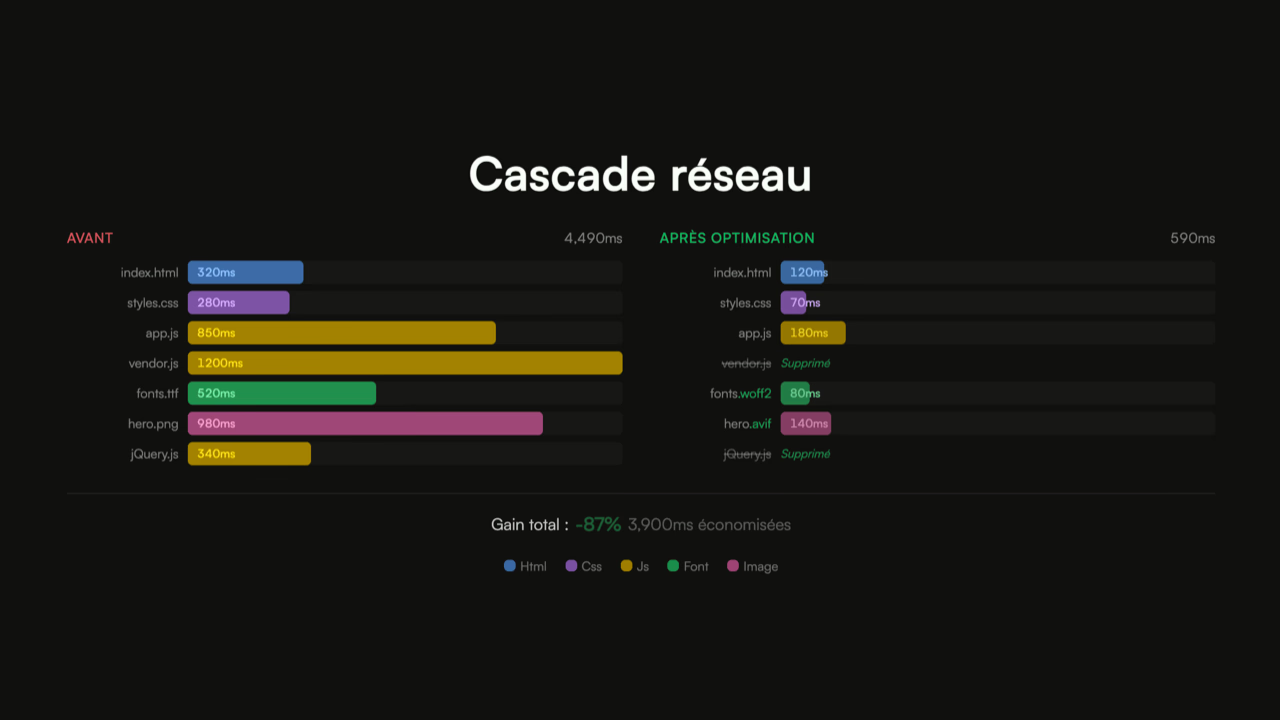
Network waterfall
Trusted by leading brands
8 years, 35+ brands supported on high-stakes websites.











La performance au service de vos objectifs
Un site pensé pour performer
Chaque site que je crée est conçu autour de quatre piliers : un design soigné, une performance irréprochable, un référencement solide et une expérience utilisateur qui convertit.
? Design sur-mesure
Un design unique adapté à votre identité, conçu mobile-first pour une expérience fluide sur tous les écrans.
⚡ Performance native
La performance n'est pas un ajout après coup : elle est intégrée dès l'architecture. Résultat : des Core Web Vitals au vert dès le lancement.
? SEO technique intégré
Balisage sémantique, données structurées, temps de chargement optimisé et architecture de contenu pensée pour le référencement naturel.
? Conversion par le design
Chaque page est structurée pour guider le visiteur vers l'action : hiérarchie visuelle, appels à l'action clairs et parcours utilisateur sans friction.
La différence se voit au chargement
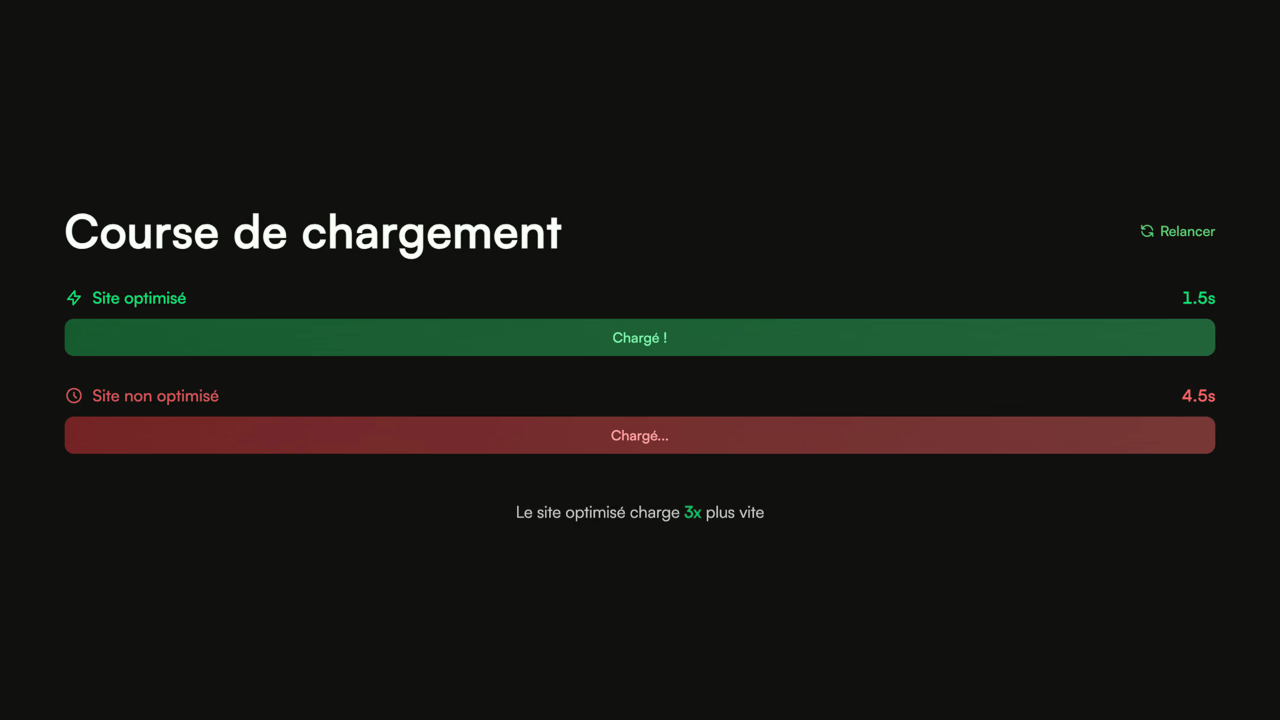
Loading race
Your visitor isn't waiting... they've gone to the competitor.
The optimized site loads 3x faster
Comment se déroule la création ?
Un processus structuré, du brief au lancement
Brief et cadrage
Compréhension de vos objectifs, de votre audience et de vos contraintes pour définir le périmètre du projet.
Conception UX et maquettes
Design des parcours utilisateurs et création des maquettes, validées à chaque étape avant le développement.
Développement performant
Intégration et développement avec un focus constant sur la légèreté du code, la rapidité de chargement et la maintenabilité.
Brief et cadrage
Compréhension de vos objectifs, de votre audience et de vos contraintes pour définir le périmètre du projet.
Conception UX et maquettes
Design des parcours utilisateurs et création des maquettes, validées à chaque étape avant le développement.
Développement performant
Intégration et développement avec un focus constant sur la légèreté du code, la rapidité de chargement et la maintenabilité.
La bonne technologie pour votre projet
WordPress, Laravel, Next.js, Astro ou solution sur-mesure : le choix technique est guidé par vos besoins, pas par une préférence personnelle.






















Core Web Vitals au vert garanti
Votre site sera livré avec un score Core Web Vitals dans le vert. Si ce n'est pas le cas au lancement, je corrige sans frais supplémentaires jusqu'à atteindre l'objectif.
Ce qu'en disent mes clients
Excellent work.
Paul has significantly improved the site's speed and perfectly aligned it with Google's recommendations.
Professional, thorough, and efficient, I highly recommend.
Nicolas - April Moto
Digital & E-commerce Director
We are very satisfied with Paul's work. He is quick, available, and particularly effective. Since his arrival, very good results have been observed, both in terms of performance and responsiveness. A real asset for our team.
Léo - Luxury brand
E-commerce Product Owner
I don't know if we've said it enough.
But if you want to improve your loading speed,
Make Google happy and get your Core Web Vitals in the green,
Contact Paul Delcloy.
Florian Darroman - Les Makers
Co-founder
Pour aller plus loin
Complete audit of your site's web performance: identification of bottlenecks, analysis of Core Web Vitals, and prioritized recommendations.
Continuous monitoring of web performance: tracking Core Web Vitals, real-time alerts, and regression detection.
Technical maintenance, security, and performance monitoring for your showcase or corporate site. A site that is always fast, secure, and up to date.
Questions fréquentes
Pourquoi choisir un consultant performance pour créer mon site ?
Quelle technologie sera utilisée pour mon site ?
Combien de temps prend la création d'un site ?
Proposez-vous la maintenance après la mise en ligne ?
Prêt à créer un site qui performe ?
Data 2023-2026
Build a fast website from day one
Web performance should never be an afterthought. Too many projects follow the same pattern: build first, optimize later, often at significant cost. My approach is the opposite: performance is a design criterion baked into the technical architecture. Framework selection, rendering strategy, asset handling, image optimization — every decision is made with speed as a design constraint.
The result is a natively fast site, with no cache or CDN layer bolted on to compensate for heavy code. A site that hits Core Web Vitals in the green from launch day, not after weeks of optimization.
Design and user experience that drive conversion
A fast site with poor design does not convert. A beautiful slow site does not convert either. Performance and design are inseparable: perceived speed is part of the user experience. A site that renders instantly builds trust and makes people want to stay.
Every page is built to guide visitors toward action: clear visual hierarchy, well-placed calls to action, optimized forms, and frictionless navigation. A mobile-first design guarantees a consistent experience across every device — where most of your audience actually is.
Technical SEO: get found so you can convert
A fast site has a built-in advantage in search. Google made Core Web Vitals an official ranking factor. But technical SEO goes far beyond speed: clean semantic markup, structured data (schema.org), a logical content architecture, clean URLs, a dynamic sitemap, and optimized server response times.
These technical foundations are built in from day one, not tacked on later by a plugin. The result: a site Google can crawl and index efficiently, with the best possible chance to rank on your target queries.
Technical choices that last
A website is a multi-year investment. The technical choices made at build time determine maintainability, scalability, and the cost of future evolution. I favor proven, well-documented technologies with an active community. The code is clean, commented, and structured so any competent developer can pick it up.
After launch, continuous performance monitoring and a maintenance contract keep the site fast, secure, and up to date as your business evolves.
Why performance has to be a design criterion, not a final add-on
Building a fast site is a different exercise from optimizing a slow one. The difference lies in when performance enters the conversation. On a project built without an initial performance constraint, every architectural decision closes a door: a CMS that imposes its conventions, a theme that dictates the HTML, a front-end stack that inflates the bundle. Optimizing after the fact means working around those accumulated constraints. Building for performance means avoiding them upfront, while the cost of the decision is still marginal.
Across eight years working on heavy refactors and from-scratch builds alike, the finding is consistent: a build driven by performance from the very first scoping workshop ships with green Core Web Vitals in production. A build that treats performance as a final-phase concern, right before launch, ships in the orange zone and will need to run through an web performance optimization cycle within three months.
The method I use bakes performance into five distinct project moments: strategic scoping, stack selection, design system, development, and go-live. At each step, decisions either preserve or degrade the final potential. Outcome quality depends on discipline across those five checkpoints.
Picking the right stack for the project and the use case
The stack choice is the first decision that locks in a site's Core Web Vitals ceiling. No stack is inherently good or bad; some fit certain use cases better than others.
For a low-traffic editorial brochure site, a classic WordPress setup with a lightweight custom theme is still a strong option. Core Web Vitals hold up without heroic effort, editorial velocity is excellent, and the ecosystem is mature. The trap: piling on plugins for convenience, which forces later optimization.
For a content-heavy corporate site, a headless architecture (decoupled CMS + statically generated front) is often the sweet spot. Astro, Eleventy, and Hugo produce pages with a minimal JavaScript footprint and unbeatable TTFB via CDN. The price: a build chain to master and a separate CMS to run.
For a highly interactive site (product configurator, transactional application, marketplace), Next.js or an equivalent modern framework remains the reference. The condition: design from day one with islands architecture and partial hydration, otherwise the JavaScript bundle explodes and INP collapses.
For high-volume e-commerce, Shopify, PrestaShop and Magento remain the dominant stacks. Each imposes its own performance constraints, but all can reach green Core Web Vitals with the right discipline on the theme and installed apps.
This choice is never purely technical. It commits editorial velocity, marketing team governance, and long-term evolution capacity. A consultant who proposes the same stack for every project is not doing the job.
What performance-driven design changes from the design phase on

A rebuild driven by a performance budget from the design workshop.
Rebuild project for a B2B tech player, catalog of 400 technical documentation pages, design team used to a heavy theme loaded with scroll animations. The initial brief mandated a field LCP under 1.5 s. Decision taken during the very first workshop: a quantified performance budget per page-type (LCP 1.2 s max, INP 100 ms max, page weight 400 KB max) that every design proposal had to respect. Result three months later: Core Web Vitals crossed into the green on go-live, no follow-up optimization phase, no painful trade-off with the design team (who had internalized the budget in their process). Compared with a similar project run without an initial budget at the same agency: three successive optimization cycles, six months to reach the same thresholds, and recurring tension between design and engineering.
This performance budget approach is the most powerful structural lever on a build. It turns performance into an acceptance criterion, not a wished-for outcome. Every mockup is validated against the budget, every component is measured before integration, every marketing integration is arbitrated on its technical cost.
On projects where I come in during the build phase, I deliver a quantified performance budget from the first workshop, with before/after measurements for every structural decision. It is a short document — six to eight pages — that carries authority throughout the project and stays in place after I leave to frame future evolutions.
The decisions that make the difference in development
Once the stack is chosen and the performance budget is set, the development phase plays out across three recurring decision categories.
Image strategy. Format selection (AVIF for the hero, WebP as fallback, JPEG as last resort), responsive sizing with conditional srcset and sizes, explicit loading priority on the LCP image via fetchpriority="high", strict lazy-loading for anything below the fold. These decisions typically win back 500 to 800 ms of field LCP on most projects.
Web font handling. Number of weights loaded (two max on most projects), font-display: swap by default, size-adjust and ascent-override descriptors on the fallback font to prevent CLS at swap time, preload conditioned on the LCP image's critical font. These decisions bring field CLS on custom fonts down to near zero.
JavaScript strategy. Zero JavaScript by default on static pages, aggressive code-splitting on interactive pages, third-party scripts loaded with defer or after first interaction, partial hydration on isolated interactive components. These decisions keep INP under 100 ms on mobile even on rich pages.
On top of those three categories, infrastructure choices: CDN enabled from development (never at the end of the project), Brotli compression in production, cache headers calibrated per resource type, TTFB monitored from the first preview deploy.
What has to ship with a site built for performance
A site built for performance is not judged only on its score at go-live. The real test is what remains six months later, once marketing teams have added their content, developers have shipped their iterations, and partners have plugged in their integrations.
On every build I support, I deliver three structuring documents that extend performance over time. A governance document defining the performance budget per page-type, the list of allowed scripts, and the rules of engagement for adding a new marketing tag or a new third-party integration. A developer guide codifying the performance patterns adopted on the project (image loading, font handling, reactive component structure) and serving as reference for future evolutions. A web performance monitoring setup wired into field Core Web Vitals, calibrated on the project's targets, with graded alert thresholds and integrated into the release workflow.
Without those three documents, the performance obtained during the build dilutes within six months. With them, the trajectory stays under control even after I step out.
What a build alone does not guarantee
Building a fast site does not exempt you from the three practices that make performance last.
A site built for performance does not replace continuous monitoring. Every editorial change, every marketing tag added, every plugin activated can introduce a regression. Monitoring stays essential, even on a site built to best practice.
A site built for performance does not replace a performance culture shared by the team that will inherit it. Without method transfer to internal developers, without marketing team awareness, without written rules of engagement, the performance obtained during the build erodes in a few months. The real deliverable of a build is not the site — it is the team's ability to keep it at its initial level.
A site built for performance does not replace the periodic web performance audit. At regular intervals, an outside look reviews the field metrics, compares them against initial targets, spots drift, and proposes corrections. That 6- to 12-month review prevents the silent accumulation of regressions.
Frequently asked questions about building a fast website
What is the difference between a performance-driven build and a classic optimization?
A performance-driven build bakes the performance constraint into the scoping phase: budget per page-type, speed-oriented stack selection, design discipline on expensive components. Classic optimization works on an existing site, with the constraints inherited from past decisions. A performance-driven build reaches the green zone without painful compromises; optimization gets to the same result at the cost of sometimes heavy trade-offs.
How long does a performance-driven build take?
The timeline matches that of a classic build with the same scope: 3 to 6 months for an editorial brochure site, 6 to 12 months for a mid-size e-commerce site, 12 months or more for a complex application. The performance budget does not stretch the project; it simply reorders decisions and avoids post-launch optimization cycles.
Can you build a fast site on WordPress?
Yes, provided you stay disciplined on the theme (lightweight custom or trimmed premium theme) and on plugins (fewer than 10 active, none redundant). For editorial brochure sites with low interactivity, WordPress reaches green Core Web Vitals without difficulty. For high-volume e-commerce or complex applications, other stacks often deliver a better effort/result ratio.
Can a classic web agency run a performance-driven project?
Rarely without external support. The performance-driven method requires cross-functional skills (front, back, infra, design, governance) that classic agencies rarely concentrate in a single team. The format that works is a pairing: the agency on design and product development, a senior consultant on the performance budget and technical validation. That configuration produces sites that stay in the green zone for years.
How much does the performance "premium" cost on a build?
Counterintuitively, the order of magnitude is close to zero on development time — often negative on total project time. Performance decisions taken early avoid the follow-up optimization cycles that cost 10 to 20 developer-days on average on a mid-size site. The workload shifts: more time in scoping and design system, less time in post-launch optimization. The real cost is measured against future editorial velocity, not against the initial budget.
Should we wait until the end of the project to test Core Web Vitals?
No — the opposite, in fact. On the performance-driven builds I support, Core Web Vitals are measured from the first HTML integrations onward, at every sprint review, on every page-type as soon as it lands in preview. Waiting until the end of the project means discovering, one month before launch, that the performance budget has been overrun by 40% cumulatively. Fixing it then becomes costly and politically sensitive. Simple rule: every page-type must validate its Core Web Vitals in preview before shipping to preprod.
Is a site built on Next.js or React automatically faster?
No — often the opposite if modern patterns are not mastered. A poorly architected Next.js site (client-rendered by default, no islands architecture, systematic hydration of the entire DOM) posts catastrophic INP on mobile. A well-designed Next.js site (targeted SSR, server components by default, islands on interactions) sits among the best possible Core Web Vitals. The stack does not make the performance — the method does.