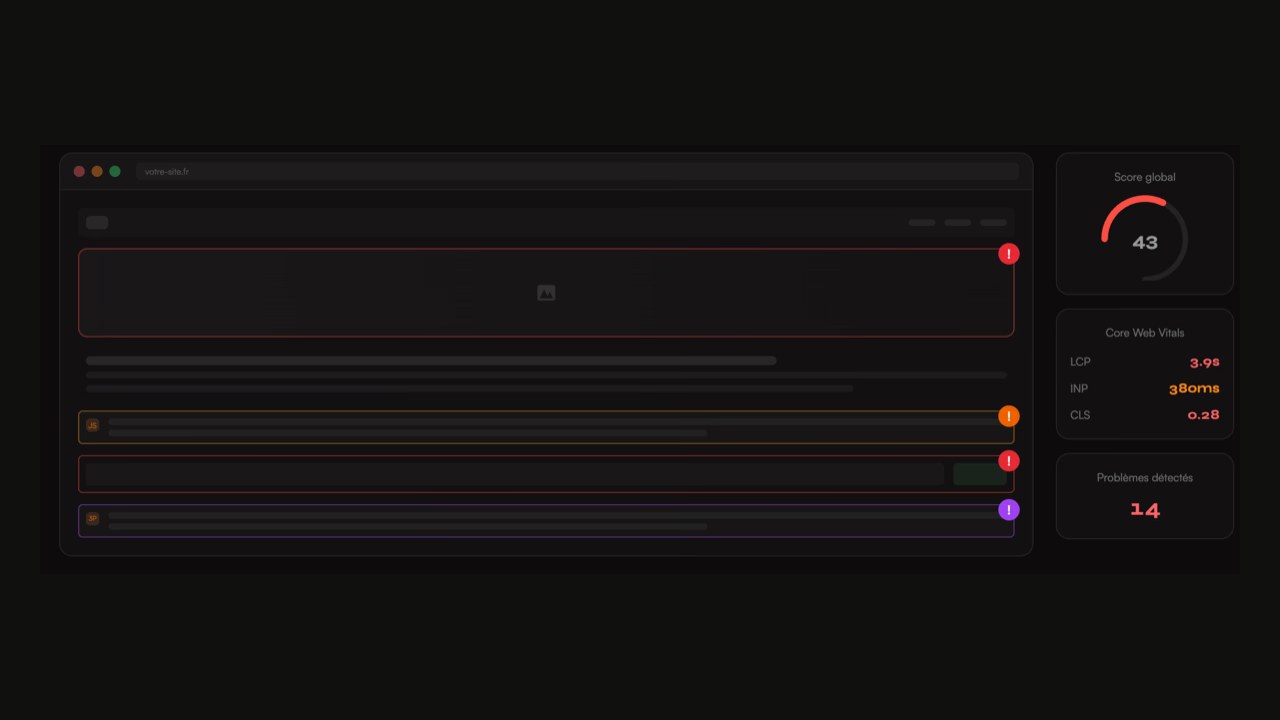
Pull maximum performance from your CDN for Core Web Vitals
Akamai, Cloudflare, Fastly: most configurations sit at defaults with perf levers unused. I optimize cache, ImageManager/Polish, Early Hints and edge compute to claw back 200 to 500ms of LCP and stabilize TTFB.
100% satisfied clients Data 2023-2026
•8+ years XP•35+ clients partnered
The CDN is rarely the sole cause of a red LCP, but it remains an underleveraged angle on most configurations.
📦 Cache hit ratio stuck under 90%
Perceived TTFB drifting, origin under pressure at every peak. Cache key, Cookie headers, marketing parameters: every lever that unlocks hit ratio drops TTFB.
🖼️ Images killing mobile LCP
ImageManager (Akamai), Polish (Cloudflare), Image Optimizer (Fastly) inactive or miscalibrated. AVIF + fetchpriority + responsive resize = 200 to 500ms of LCP recovered.
⚡ Critical path not prioritized via the CDN
Resource Hints, Early Hints (HTTP 103), asset prioritization: every CDN can push them at the edge. Combo that unblocks mobile LCP.
🌍 Latency varying with geography
Adaptive Acceleration, Argo Smart Routing, Tiered Cache. Enterprise features exist, you just need to activate them for the traffic profile.
🧹 Property Manager / Cache Rules piled up without audit
Obsolete rules canceling each other, Cookie exclusions breaking the cache. A complete audit typically frees 10 to 30 hit ratio points.
💰 CDN bill climbing without perceived gain
Bad cache configuration, overly permissive Vary, too-frequent purges. Optimizing the cache drops the bill and accelerates the site in the same move.
Three CDNs, three angles, one shared discipline
I work on Akamai, Cloudflare and Fastly based on what's in place. The choice depends on business context, not tool preference.
Angular
Astro
Drupal
Laravel
Python
React
Salesforce Commerce Cloud
SAP Commerce Cloud
Sylius
Symfony
Akamai mPulse
Datadog
Dynatrace
SpeedCurve
Akamai
Cloudflare
Fastly
Magento
Prestashop
Shopify
Wordpress
Medusa.js
Ruby on Rails
Angular
Astro
Drupal
Laravel
Python
React
Salesforce Commerce Cloud
SAP Commerce Cloud
Sylius
Symfony
Akamai mPulse
Datadog
Dynatrace
SpeedCurve
Akamai
Cloudflare
Fastly
Magento
Prestashop
Shopify
Wordpress
Medusa.js
Ruby on Rails
Angular
Astro
Drupal
Laravel
Python
React
Salesforce Commerce Cloud
SAP Commerce Cloud
Sylius
Symfony
Akamai mPulse
Datadog
Dynatrace
SpeedCurve
Akamai
Cloudflare
Fastly
Magento
Prestashop
Shopify
Wordpress
Medusa.js
Ruby on Rails
AngularAstroDrupalLaravelPythonReactSalesforce Commerce CloudSAP Commerce CloudSyliusSymfonyAkamai mPulseDatadogDynatraceSpeedCurveAkamaiCloudflareFastlyMagentoPrestashopShopifyWordpressMedusa.jsRuby on RailsAngularAstroDrupalLaravelPythonReactSalesforce Commerce CloudSAP Commerce CloudSyliusSymfonyAkamai mPulseDatadogDynatraceSpeedCurveAkamaiCloudflareFastlyMagentoPrestashopShopifyWordpressMedusa.jsRuby on RailsAngularAstroDrupalLaravelPythonReactSalesforce Commerce CloudSAP Commerce CloudSyliusSymfonyAkamai mPulseDatadogDynatraceSpeedCurveAkamaiCloudflareFastlyMagentoPrestashopShopifyWordpressMedusa.jsRuby on RailsAngularAstroDrupalLaravelPythonReactSalesforce Commerce CloudSAP Commerce CloudSyliusSymfonyAkamai mPulseDatadogDynatraceSpeedCurveAkamaiCloudflareFastlyMagentoPrestashopShopifyWordpressMedusa.jsRuby on RailsAngularAstroDrupalLaravelPythonReactSalesforce Commerce CloudSAP Commerce CloudSyliusSymfonyAkamai mPulseDatadogDynatraceSpeedCurveAkamaiCloudflareFastlyMagentoPrestashopShopifyWordpressMedusa.jsRuby on RailsAngularAstroDrupalLaravelPythonReactSalesforce Commerce CloudSAP Commerce CloudSyliusSymfonyAkamai mPulseDatadogDynatraceSpeedCurveAkamaiCloudflareFastlyMagentoPrestashopShopifyWordpressMedusa.jsRuby on RailsAngularAstroDrupalLaravelPythonReactSalesforce Commerce CloudSAP Commerce CloudSyliusSymfonyAkamai mPulseDatadogDynatraceSpeedCurveAkamaiCloudflareFastlyMagentoPrestashopShopifyWordpressMedusa.jsRuby on RailsAngularAstroDrupalLaravelPythonReactSalesforce Commerce CloudSAP Commerce CloudSyliusSymfonyAkamai mPulseDatadogDynatraceSpeedCurveAkamaiCloudflareFastlyMagentoPrestashopShopifyWordpressMedusa.jsRuby on RailsAngularAstroDrupalLaravelPythonReactSalesforce Commerce CloudSAP Commerce CloudSyliusSymfonyAkamai mPulseDatadogDynatraceSpeedCurveAkamaiCloudflareFastlyMagentoPrestashopShopifyWordpressMedusa.jsRuby on RailsAngularAstroDrupalLaravelPythonReactSalesforce Commerce CloudSAP Commerce CloudSyliusSymfonyAkamai mPulseDatadogDynatraceSpeedCurveAkamaiCloudflareFastlyMagentoPrestashopShopifyWordpressMedusa.jsRuby on Rails
Mission commitments
+30 ptstypical cache hit ratio gained
-500msLCP via ImageManager / Polish / Image Optimizer
Akamai vs Cloudflare vs Fastly for web performance?
All three improve performance once well-configured. Akamai: superior global coverage, most advanced enterprise features. Cloudflare: best features/price ratio, well-suited for SMBs and scale-ups. Fastly: programmable VCL, instant purge, leader among media and premium e-commerce.
Is my CDN really underleveraged?
On 9 out of 10 audits, yes. Default configurations cover the basics but leave 200 to 500ms of LCP and 10 to 30 cache hit ratio points on the table. The diagnosis quantifies the accessible gains within days.
Should I change CDN to optimize?
Rarely. Most gains come from optimizing the existing configuration. CDN change is a project in itself, justified only on specific constraints (enterprise security, critical programmability, geographic audience).
How are your CDN engagements structured?
As continuous sprints. Initial diagnosis, then each sprint pushes a lever (cache hit ratio, ImageManager, Workers, Early Hints) with measurement via mPulse or SpeedCurve. A well-tuned CDN in March drifts if nobody watches it in September.
Get your LCP green through your CDN
Complete CDN config audit
Measurable LCP gains
Long-term partnership
100% satisfied clients
Data 2023-2026
Testimonials
What my clients say
Excellent work.
Paul has significantly improved the site's speed and perfectly aligned it with Google's recommendations.
Professional, thorough, and efficient, I highly recommend.
Nicolas - April Moto
Digital & E-commerce Director
We are very satisfied with Paul's work. He is quick, available, and particularly effective. Since his arrival, very good results have been observed, both in terms of performance and responsiveness. A real asset for our team.
Léo - Luxury brand
E-commerce Product Owner
I don't know if we've said it enough.
But if you want to improve your loading speed,
Make Google happy and get your Core Web Vitals in the green,
Contact Paul Delcloy.
Florian Darroman - Les Makers
Co-founder
CDN, major lever on TTFB and LCP
A well-configured CDN can gain 200 to 500ms of mobile LCP and 30 to 60% of perceived TTFB. A misconfigured CDN costs a fortune, fragilizes stability, and creates the illusion of optimization without delivering results. On missions where the CDN is already in place, I almost systematically find 10 to 30 cache hit ratio points to recover and several hundred milliseconds of LCP to gain.
The CDN isn't a product you activate — it's a layer you configure. Cache key, Vary headers, ImageManager or Polish, Resource Hints, EdgeWorkers, Early Hints: every lever impacts TTFB and LCP, and every lever deserves a configuration aligned with the real traffic profile of the site.
Three players, three intervention angles
I work on the three most-deployed CDNs in France and Europe. Each has its logic, strengths, traps. The choice depends on business context, not tool preference.
Akamai remains the most complete CDN for enterprise (superior global coverage, enterprise security features, native mPulse integration). It's the default choice above a certain traffic level or for contractual security constraints. A default Akamai configuration covers the basics, an optimized one transforms Core Web Vitals.
Cloudflare offers the best features/price ratio on the market. Polish, Cache Rules, Workers, Early Hints, APO, HTTP/3, Brotli: every performance lever exists natively, you just need to activate them in the right order and calibrate. It's the most cost-effective choice for SMBs and scale-ups.
Fastly is the most programmable CDN on the market. Custom VCL, sub-second instant purge, Compute@Edge: it's the choice of media publishers and premium e-commerce who need to program the edge layer.
Cache hit ratio, the indicator that counts
Across all CDNs, cache hit ratio remains the central indicator. The higher it is, the more perceived TTFB drops, and the more the origin is protected from traffic peaks. A site without cache hit ratio optimization caps at 70-85%. With a complete audit (cache key, Cookie exclusions, disciplined Vary, SWR strategy), it exceeds 95%.
That level frees two immediate gains: TTFB dropping (every request served from the edge takes 30-80ms instead of 300-1000ms through the origin), and origin bill shrinking. Cache audit is almost always the most cost-effective lever of a CDN intervention.
Images, next-gen formats and critical path
Images account for 50 to 70% of page weight on most sites. Each CDN proposes its optimization module: ImageManager on Akamai, Polish on Cloudflare, Image Optimizer on Fastly. Well-configured (AVIF, WebP, responsive resizing, LCP prioritization), they gain 200 to 500ms of mobile LCP without touching application code.
The critical path is the other angle. Resource Hints, Early Hints (HTTP 103), fetchpriority on the LCP image, critical font preloading: each optimization gets measured individually via mPulse or SpeedCurve, and cumulated it turns Search Console from red to green.
Edge compute, the emerging lever
Workers (Cloudflare), EdgeWorkers (Akamai), Compute@Edge (Fastly): all three CDNs now offer edge code execution. Well-used, it's a major performance lever — origin-roundtrip-free A/B testing, instant geo redirect, image proxying, header manipulation to optimize the cache. Misused (heavy templating, full SSR), it's an added cost without real gain.
The edge compute intervention angle consists of identifying use cases that actually win performance, implementing them cleanly (tests, real-time log monitoring), and avoiding anti-patterns.
My CDN engagements
My CDN engagements run over time. The initial diagnosis frames the stack and the roadmap, then each sprint pushes a lever (cache hit ratio, ImageManager, Workers, Early Hints) with measurement via mPulse, SpeedCurve or integrated CDN analytics. A well-tuned CDN in March drifts if nobody watches it in September — a continuous engagement protects what makes performance.
The angle stays constant: drop TTFB, accelerate LCP, stabilize Core Web Vitals, without touching application code when possible. The CDN is a powerful lever provided it's treated as a layer to design and maintain, not a product you activate once and forget.
E-commerce store, corporate site, or media: enhance your UX to increase your conversion rate with a web performance consultant integrated into your teams.